If you're thinking about buying a Toronto condo, waiting until 2027 may sound tempting. Prices have fallen from their recent highs, buyers have more negotiating room than they did a few years ago, and there is a reasonable argument for waiting to see what happens next.
But there is an equally important point: nobody knows exactly what Toronto condo prices, mortgage rates or inventory will look like in 2027. The better question isn't whether prices will be higher or lower next year. It's whether buying now makes sense for your financial situation, your timeframe and the particular condo you're considering.
The Toronto market has already changed significantly. Condo prices remain below their year-ago levels, while condo sales have improved in some periods and inventory remains sufficiently elevated to give buyers meaningful choice and negotiating room. However, the market isn't simply moving in one direction.
This article uses Greater Toronto Area data unless it specifically refers to the City of Toronto.
So before deciding to wait until 2027, it's worth understanding what you're actually waiting for, and what you might gain or give up by waiting.
What is happening in the Toronto condo market right now?
The Toronto condo market in 2026 is quite different from the market many buyers remember from the pandemic years. Buyers are generally not facing the same level of competition or urgency, and prices remain below their 2025 levels.
TRREB reported 4,783 GTA condominium-apartment sales in Q2 2026, an 8.8% increase compared with Q2 2025. At the same time, 14,042 new condo listings came onto the market, down 19%, while active listings at the end of the quarter were down 15.4%. The average GTA condo selling price was $634,972, down 7.5% from a year earlier.
In the City of Toronto specifically, the Q2 average condo selling price was $667,916, compared with $717,403 in Q2 2025. That represents a substantial year-over-year decline.
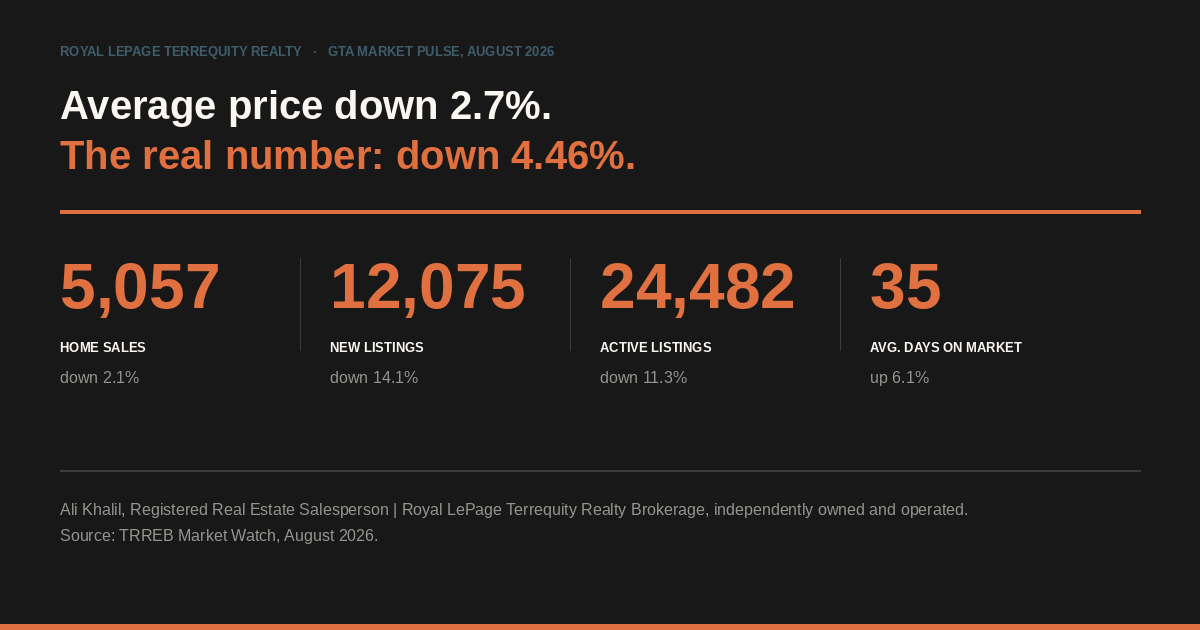
More recent August data showed that the GTA condo market remained soft. The average GTA condominium-apartment price was $617,593, roughly 3.6% to 3.8% below August 2025, while 1,330 condo apartments changed hands.
In the City of Toronto, the August average condominium-apartment price was reported at $651,648, compared with $549,868 in the 905 area. These figures should not be confused with the GTA-wide average.
The market data therefore tell a mixed story. Prices are lower than a year earlier, Q2 sales were higher than a year earlier, and new and active listings declined year over year. At the same time, inventory remained elevated enough in the broader market to preserve meaningful buyer choice and negotiating power.
For buyers, one of the biggest changes is therefore not simply price. It's time. You can compare buildings, investigate maintenance fees, review status certificates, negotiate price and walk away from a condo that doesn't make sense without assuming another buyer will immediately take it.
That doesn't necessarily mean you should buy today. It does mean that waiting until 2027 isn't automatically the only way to get a better deal.
What could happen if you wait until 2027?
There are several perfectly reasonable reasons a buyer might wait. You may need more time to build your down payment. You may be working on your credit or paying down other debt. You may not know whether you'll remain in Toronto for the next few years. Or perhaps today's mortgage payment simply doesn't fit comfortably within your budget.
Those are personal reasons to wait, and they're often more important than trying to predict the market.
The harder question is whether waiting because you expect Toronto condos to become substantially cheaper in 2027 is a sound assumption. Current market evidence doesn't give us a reliable answer to that.
TRREB's 2026 market outlook identified affordability pressures and elevated inventory as factors affecting the GTA market. It also suggested that improving borrowing conditions and buyer confidence could support demand. TRREB expected elevated inventory to provide buyers with substantial negotiating power, particularly in the condo market, while also projecting the possibility of market stabilization if demand improved.
More recent data also show that sales, new listings and active listings can move in different directions. That makes trying to time the exact bottom extremely difficult.
If demand strengthens while inventory continues to fall, buyers could potentially face less selection or more competition. On the other hand, if economic conditions weaken or affordability remains challenging, buyers could continue to have negotiating leverage. Both outcomes are possible. Neither should be treated as a prediction.
Instead of asking, "Will Toronto condos be cheaper in 2027?" a more useful question is: "If the condo I want becomes available at a price I can comfortably afford today, would I be happy owning it for the next five to seven years?" That is a question you can actually answer.
What should you consider before deciding to buy now?
Your time horizon. Buying a condo comes with transaction costs, financing costs and ongoing ownership expenses. If you're likely to move again in a year or two, buying may be harder to justify than if you expect to stay for five years or longer. Five to seven years is not a universal minimum. It is simply a useful planning horizon for considering whether the expected benefits of ownership are likely to justify the costs of buying and eventually selling.
Monthly affordability. Don't base the decision solely on the purchase price. Look at the mortgage payment, property taxes, maintenance fees, insurance and a reasonable allowance for unexpected expenses. A condo that looks inexpensive on the listing page may not be inexpensive to own. This is particularly important in Toronto because maintenance fees can vary dramatically between buildings. Two condos at similar prices can have very different monthly carrying costs. A buyer should also consider whether the budget would remain manageable if maintenance fees, property taxes, insurance or borrowing costs increase.
The building itself. A lower purchase price isn't necessarily a bargain if the building has significant maintenance issues, unusually high fees or substantial upcoming expenses. For a resale condo, review the status certificate and understand the corporation's financial position. A status certificate can provide information about the condo corporation, reserve fund, common expenses, fee increases, special assessments and certain legal or financial matters. Because the implications can be significant, buyers should have a real-estate lawyer review the status certificate, particularly if the building has litigation, major repairs, a weak reserve fund or proposed special assessments.
What you give up by waiting
If you rent, waiting means continuing to rent while you save or wait for market conditions to change. That isn't necessarily a bad decision, renting can provide flexibility, but it is part of the calculation.
Waiting may also allow you to build a larger down payment, reduce debt or improve your financial resilience. But it can also mean that a suitable unit sells, mortgage rates change, or the market becomes more competitive before you are ready to buy.
The goal shouldn't be to predict the market perfectly. It should be to make a purchase that still makes sense if the market doesn't behave exactly as you expected.
Is there a right answer for Toronto buyers in 2026?
There isn't one answer that applies to every buyer. Someone with a stable income, a healthy emergency fund, a reasonable down payment and a five-to-seven-year ownership horizon may look at today's market very differently from someone who would have to stretch financially to buy. The same applies to the property itself.
A well-maintained condo in a location you want, at a price that fits your finances, is a different proposition from buying a condo simply because you believe prices have fallen enough.
The current market gives buyers an interesting combination: prices remain below year-ago levels, Q2 sales were higher than a year earlier, and new and active listings declined year over year. However, inventory remained elevated enough to preserve meaningful negotiating power in the broader market. That does not tell us what 2027 will bring, but it does suggest that buyers should evaluate actual properties rather than rely exclusively on a market forecast.
If you're financially ready but waiting solely because you're hoping for a perfectly timed bottom, it may be worth looking at actual properties rather than making the decision based on a market forecast. And if you're not financially ready, there is nothing wrong with waiting. In that situation, the goal of the next several months can be to put yourself in a stronger position so that you're ready when the right opportunity appears.
Frequently Asked Questions
Is it better to buy a Toronto condo now or wait until 2027? There is no reliable way to know whether buying now or waiting will produce the lower purchase price. The more useful comparison is whether you can comfortably afford the property today and whether you plan to own it long enough for the purchase to make sense.
Will Toronto condo prices go up in 2027? No one can reliably predict Toronto condo prices for 2027. Current market conditions show prices below year-ago levels alongside changes in sales and inventory. Those trends can change as economic and borrowing conditions evolve.
Are Toronto condos cheaper than they were last year? On average, yes. In Q2 2026, the average City of Toronto condominium-apartment selling price was $667,916, compared with $717,403 in Q2 2025. In August 2026, the average GTA condominium-apartment price was $617,593, roughly 3.6% to 3.8% below August 2025. The GTA figure should not be presented as the City of Toronto average.
Should first-time buyers wait for mortgage rates to fall before buying a Toronto condo? Waiting solely for a lower rate involves another uncertainty: purchase prices, available inventory and market competition can change while you wait. A buyer should look at the complete monthly cost and their ability to manage the mortgage rather than assuming that today's rate will determine the entire cost of ownership. A mortgage professional can help compare fixed-rate, variable-rate and renewal scenarios based on the buyer's actual finances.
How long should you plan to own a Toronto condo? There isn't a universal minimum, but buyers should consider whether they expect to stay long enough to justify the costs associated with purchasing and selling. A very short ownership period can make transaction costs more significant. A five-to-seven-year period can be a useful planning benchmark, but it is not a guarantee that buying will be financially beneficial.
What should I check before buying a Toronto condo in 2026? Look beyond the unit itself. Review the building's financial position, maintenance fees, reserve fund, recent or anticipated major repairs, property taxes and the status certificate. You should also compare the condo with recent sales of genuinely similar units before deciding what it is worth. A lawyer should review the status certificate, and buyers should investigate any special assessments, major litigation, reserve-fund concerns or unusual fee increases before waiving conditions.
Local example: Liberty Village
Take Liberty Village as an example. A buyer considering a condo there isn't simply deciding whether Toronto's overall average price will rise or fall. They're choosing between individual buildings, unit sizes, maintenance fees, layouts, views, amenities and proximity to transit and the downtown core.
As of Q2 2026, the average City of Toronto condominium-apartment selling price was $667,916, compared with $717,403 a year earlier. The broader number provides useful market context, but a Liberty Village buyer still needs to compare recent sales, unit-specific characteristics and carrying costs for the specific buildings and units they're considering.
A citywide average cannot establish the value of a particular Liberty Village unit. The most relevant comparisons are usually recent sales in the same building or in genuinely comparable nearby buildings, adjusted for size, floor, exposure, parking, locker, renovations and maintenance fees.
Market statistics in this article are based on TRREB reports and should be updated when new monthly or quarterly data are released. General information about status certificates and condo corporations is based on guidance from the Condominium Authority of Ontario. Ali Khalil is a registered Real Estate Salesperson with Royal LePage Terrequity Realty, Brokerage (independently owned and operated).