By Ali Khalil, Registered Real Estate Salesperson, Royal LePage Terrequity Realty, Brokerage
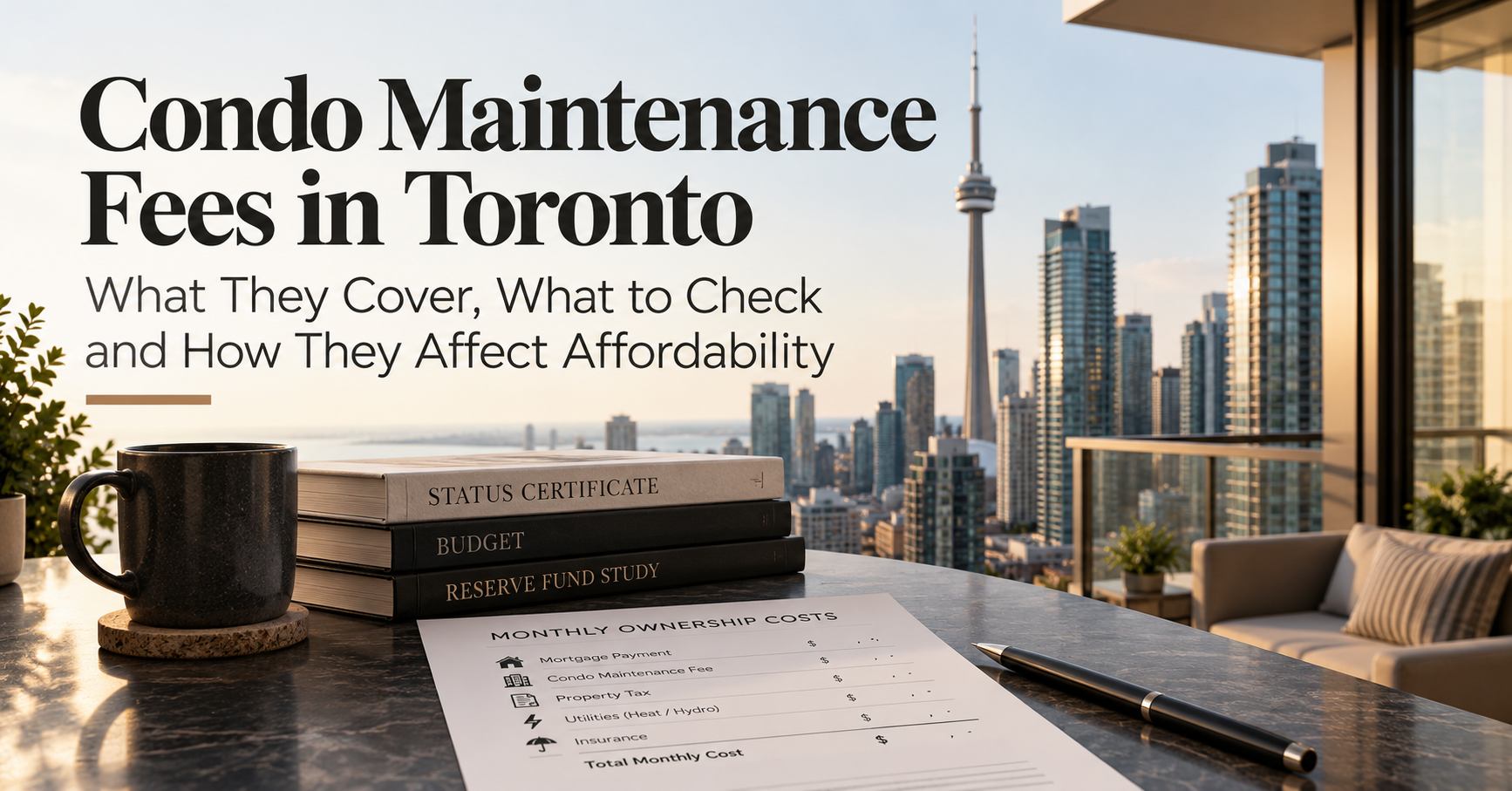
A maintenance fee is not a flat price for living in a building. It is your share of the corporation's yearly budget, and it can change. Before you compare Downtown Toronto condos on price alone, compare the monthly fee, what it includes, and what the status certificate says about the reserve fund and future costs. For a renter used to a fixed rent, that shift in thinking is the main decision, and it is easier to make before you write an offer than after.
What do maintenance fees actually pay for, and what do they leave out?
The Condominium Authority of Ontario (CAO) explains that common expenses fund the maintenance of the common elements, contributions to the reserve fund, and services such as cleaning, building maintenance and condo management. In a Downtown Toronto building, that usually means the lobby, hallways, elevators, garage, and any shared amenities, along with the people and contracts that keep them running.
Your fee is not set by negotiation. According to the CAO, each owner's share is a percentage set out in the corporation's declaration, and your amount comes from multiplying the annual budget by that percentage. Unit size can affect the percentage, so two units in the same tower can carry different fees.
What the fee covers varies from building to building. Some corporations include heat, water or air conditioning in the common expenses, while others bill some utilities separately. A lower fee is not automatically a better deal if you will pay for utilities on top of it. Ask for a written list of what is included, and compare it line by line between buildings.
Several costs sit outside the monthly fee entirely:
Why do maintennce fees deserve extra attention in Downtown Toronto?
Downtown buildings often come with more to operate. A tower with a concierge, a gym, shared lounges and a pool has more systems to staff, clean, insure and eventually replace than a small low-rise. That is general reasoning rather than a rule, because fees depend on each corporation's budget, age, size and management. It does mean you should not assume that two downtown condos with similar prices will cost the same to carry.
Age matters in both directions. A newer building may start with a lower fee that is based on early budget estimates, and those estimates can change once the building has a few years of real costs behind it. An older building may have a higher fee that already reflects ageing equipment, or it may have a fee that is too low and a reserve fund that has not caught up. Neither is automatically better. The documents tell you more than the building's age does.
If you are considering new construction, please go in with eyes open. Pre-construction and new-build condo purchases come with a lot of fine print, including how the fee is estimated, what the budget statement assumes and when fees can change. Ask a lot of questions, put them in writing where you can, and have a real estate lawyer review the agreement before you sign.
For a renter, the practical point is that a fee is a recurring cost with no equity attached to it. It deserves the same scrutiny as the mortgage payment, because it is paid every month for as long as you own the unit.
What should you read in the status certificate before you go firm?
The status certificate is the most useful document a condo buyer can ask for. The CAO says anyone can request one, the corporation can charge up to $100 including all applicable taxes, and it must be provided within 10 days. It is worth the wait and the cost, because it shows the corporation's financial position at that time.
According to the CAO, a status certificate includes the declaration, by-laws and rules, the current budget and audited financial statements, information on the reserve fund study and the state of the reserve fund, details about common expenses and any arrears, a statement of any increase in common expenses and the reason, special assessments charged since the start of the budget year, insurance certificates, and disclosure of judgments or ongoing litigation.
A special assessment is an extra one-time charge on top of regular fees. The CAO says a board can levy one without owner approval, usually after a large unexpected expense, under-budgeting for repairs, or legal costs. Every owner pays a share using the same percentage as the common expenses. If it goes unpaid, the corporation can register a lien against the unit.
You can read these documents before you make a decision, and you should read them before you remove your conditions. If something in them worries you, a condition that gives you time to review the status certificate is the place to protect yourself. A lawyer who knows condo documents can explain the legal effect of what you find.
How do maintenance fees change what you can afford?
The fee needs to be part of your budget from the start, not an afterthought once you like a unit. When you compare two condos, compare the combined monthly cost: mortgage payment, property tax, condo fee, heat and hydro if they are billed to you, and insurance. A unit with a lower price and a higher fee can cost more each month than a slightly pricier unit with a lower fee.
Here is a hypothetical example. These numbers are for illustration only and are not a quote or a market figure. Suppose Unit A has a monthly fee of $500 and Unit B has a monthly fee of $750. The difference is $250 a month, or $3,000 a year. Over five years that is $15,000 before any fee increases, and it is money that does not reduce your mortgage or build equity.
Lenders also look at condo fees when they assess how much you can borrow. Lenders generally count 50% of the monthly condo fee when they calculate qualification, so a higher fee can reduce the mortgage amount you qualify for. Treatment can vary by lender, so ask your lender or mortgage professional how the fee on a specific unit would be counted before you make an offer.
If you are still deciding on timing, our post on whether to buy a Toronto condo now or wait until 2027 covers that question, and The First-Time Buyer's Compass answers more of the common process questions.
Finally, build in room for change. Fees can rise, and a special assessment is possible in any building. A modest cushion in your monthly budget, and a sense of how the reserve fund has been managed, will protect you better than any single number will.
Frequently Asked Questions
Are maintenance fees the same as property tax?
No. Property tax is billed separately by the municipality, and condo fees are paid to the condo corporation. Both are ongoing costs of ownership, so both belong in your monthly budget.
Can maintenance fees go up after I buy?
Yes. Fees follow the corporation's budget, and the budget can change. The status certificate includes a statement of any increase in common expenses and the reason, which helps you see the recent history.
What is a reserve fund?
It is money the corporation sets aside for major repairs and replacement of common elements. Reserve fund studies are required every three years, and they estimate what the fund needs in order to cover future repairs. The CAO notes that common expenses include contributions to the reserve fund, and that the status certificate includes information on the reserve fund study and the state of the fund.
Who can see a status certificate, and what does it cost?
According to the CAO, anyone can request one. The corporation can charge up to $100 including all applicable taxes, and it must provide the certificate within 10 days.
Does a lower condo fee mean a better building?
Not necessarily. A low fee may reflect fewer amenities, or it may mean the reserve fund is not being topped up enough. Compare what is included, the reserve fund position and any recent special assessments before you decide.
Should I have a lawyer review the condo documents?
Yes. A real estate lawyer can review the status certificate and the agreement of purchase and sale and explain the legal effect. This article is general education and is not legal advice.
Local proof: Downtown Toronto
Downtown Toronto is a market where this homework pays off, because many first-time buyers here are comparing condo towers in neighbourhoods such as King West, the Entertainment District, the Financial District and the Waterfront. The rules above apply to every condo corporation in Ontario, and they are the same whether the building is in Liberty Village or Yorkville. The CAO page on common expenses was last updated on April 6, 2026, and the CAO page on status certificates was last updated on August 12, 2026.
Thinking about buying your first condo downtown?
Would it help to walk through a building's fee, reserve fund and status certificate together before you make an offer? I am happy to have a calm, no-pressure conversation about your budget and the buildings on your list. You can book a consultation at alikhalil.ca, call me, Ali Khalil, at 289-442-5154, or email alikhalil@royallepage.ca.