By Ali Khalil, Registered Real Estate Salesperson, Royal LePage Terrequity Realty, Brokerage
It can be, if the numbers and your plans both work. Downsizing in the GTA means weighing what your home would net against what the next one costs, and many owners also ask whether leaving, for another province or another country, would leave them better off. This guide compares those three options in the same order, with a calculator to run your own figures. It is general education, not mortgage, tax, legal or immigration advice.
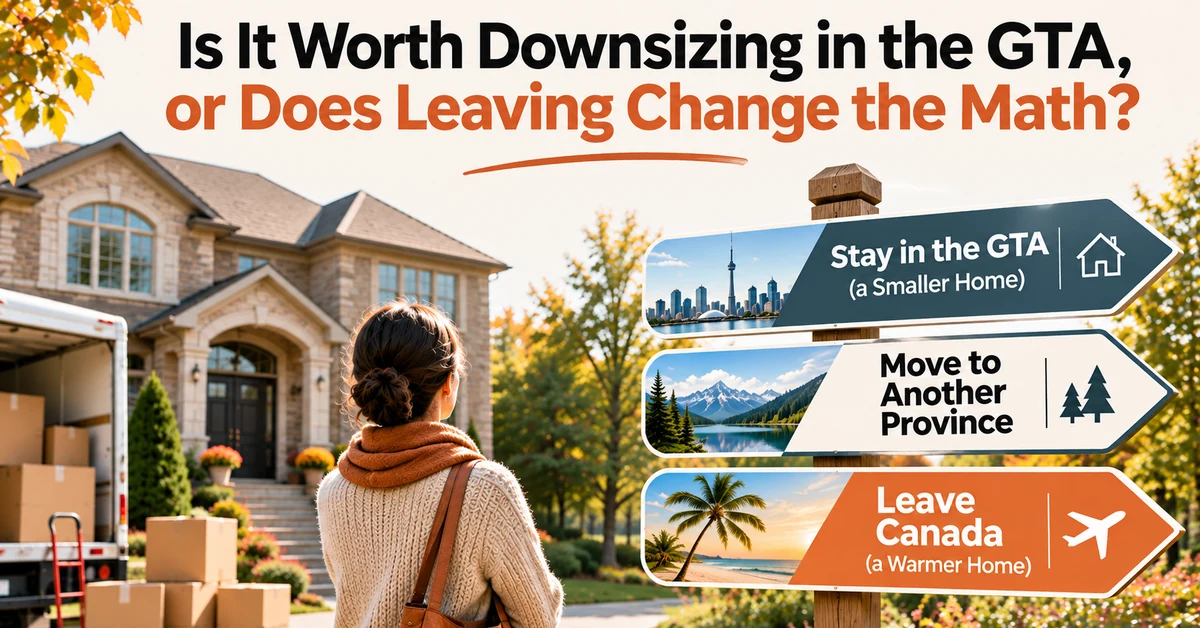
Is it worth downsizing in the GTA, or does leaving change the math?
Start with prices. TRREB reported that the MLS Home Price Index Composite benchmark for the GTA was down 4.3% in October 2026 compared with October 2025, and that the average selling price was $1,024,108, down 2.7% (TRREB news release, November 4, 2026). For comparison, CREA reported a national average sale price of $678,584 for October 2026, down 1.6% (CREA, November 17, 2026). Averages mix home types and neighbourhoods, so the comparison that counts is one real home against another, using recent sold prices.
Rates matter too. On October 28, 2026, the Bank of Canada raised its target for the overnight rate by 25 basis points to 2.5%, with the next announcement on December 9, 2026 (Bank of Canada, October 28, 2026). The policy rate does not set your mortgage rate, so ask your lender what it means for you. If you still carry a mortgage, ask whether it can move with you and what it would cost to break.
Staying has value a spreadsheet misses. Some people want to stay in the neighbourhood they know, near their doctor, their place of worship, their friends and their family. Others want a walkable area. Many downsizers are choosing between a condominium apartment, a townhouse, a bungalow or a home with a main-floor bedroom, and a retirement residence. Whatever you compare, ask the same questions of each option:
- Stairs and layout. Are you okay to navigate stairs or would you rather avoid them?
- Upkeep. Decide how much yard work, snow clearing and repair work you want to take on.
- Daily life. Note how far you would be from family, health care, shopping, transit and the places you go every week.
- Space. Measure the furniture you plan to keep, and ask where guests and storage will go.
What should you weigh before moving to another province?
For July 2024 to June 2025, Statistics Canada’s preliminary estimates show that 82,729 people left Ontario for another province or territory, while 64,950 moved to Ontario from elsewhere in Canada. A net interprovincial loss of 17,779. Of those leaving Ontario, 25,762 moved to Alberta. These figures were reported in a Narcity article citing Statistics Canada, and more recent migration data have since been released. Statistics Canada has found that people become less likely to move between provinces as they age, with rates falling steadily past about age 50 (Statistics Canada, 2021, covering 2016/17 to 2018/19). I could not find a current breakdown of older movers by destination, so treat stories about where retirees go as anecdote until you see data.
A move can free up money if the next home costs less, but that depends on the city and the home type, so compare sold prices for the specific kind of home there. Closing taxes and fees differ by province, so ask a real estate lawyer there.
Some people move for a milder winter and less snow, and some to spend less. Both are fair goals, so price the home, the monthly costs and your trips back to see family.
What about leaving Canada for somewhere warmer?
Some owners consider leaving the country for a warmer climate, lower costs, or both. Statistics Canada's quarterly estimates, as reported by The Hub, show 120,640 citizens and permanent residents emigrated in 2025 (The Hub, June 29, 2026). In 2021, people 65 and over made up 7.3% of emigrants but 18.6% of the Canadian population, and about two-thirds of emigrants were 20 to 44 (Statistics Canada, Portrait of Canadian emigration, March 18, 2026). An analysis of Statistics Canada's annual estimates puts emigrants aged 55 and over at 16,609 in 2025, about 13.8% of the total (Better Dwelling, January 22, 2026). None of these counts shows why people leave. The 120,640 figure was Statistics Canada’s June 2026 estimate for 2025 emigration, later revised to 111,572. The 16,609 figure for people aged 55+ and the 13.8% share were Better Dwelling’s presentation of StatCan data; the percentage was based on the pre-revision total.
The Canada Revenue Agency says you are an emigrant if you leave Canada to live in another country and sever your residential ties, and that when you leave you may have to report a capital gain on certain property, known as departure tax (CRA, Leaving Canada (emigrants), page modified September 17, 2026). Whether those rules apply to your home and other assets is a question for an accountant who handles cross-border tax, ideally before you list. Immigration questions belong with a licensed immigration professional, and buying abroad needs a lawyer there.
How do you compare staying and leaving, step by step?
Work through it in this order for each option, and ask for estimates in writing as you go.
- Estimate what your current home will net. Start with the expected sale price, then subtract what you still owe on your mortgage, any penalty to break it, legal fees and the commission on your sale.
- Add land transfer tax on the next home. The buyer pays it at closing. Ontario's tax applies province-wide, and the City of Toronto adds its own tax on purchases inside the City, but not in surrounding municipalities such as Mississauga. On a hypothetical $700,000 home, my own calculation from the published rates comes to $10,475 outside the City and $20,950 inside it (Province of Ontario and City of Toronto rate pages, reviewed November 2026). Your lawyer will confirm the figure, and rates change above $2,000,000. Another province or country will have its own taxes and fees.
- Add the monthly costs of the new home. Property tax and insurance apply to every type of home. Condos have maintenance fees and freehold properties have utilities, insurance, upkeep, etc.
- If it is a condominium, request the status certificate. Do it before you remove conditions on the purchase. It summarizes the corporation's finances, including the budget, the reserve fund and any special assessments. A real estate lawyer can explain what it means for you and should review it before you make a final decision. They typically only take a day or two to do so.
- Add moving and set-up costs. Include movers, any repairs or updates, and furniture you plan to replace. A long-distance or international move costs more.
- Compare totals. A house has its own repair and maintenance costs too, so compare the total cost of each option instead of a single line.
My downsizing calculator does these steps for up to three options side by side: staying in the GTA, another province and another country. It works out Ontario land transfer tax and gives estimates only.
The order of the sale and purchase matters as well. Most downsizers choose one of three routes.
- Sell first, then buy. You know your proceeds before you commit to a new home, but you may need temporary housing between closings.
- Buy first, with a condition on the sale of your home. This can give you time to find the right place. Most sellers prefer an offer without that condition and some may not accept it at all.
- Match the closing dates. Both deals close on the same day, which needs close coordination between your realtor, your lawyer, and their lawyer.
If you buy before you sell, ask your lender whether short-term bridge financing is available and what it costs, and do not assume it exists until you have it in writing.
Frequently asked questions
Will I need to pass the mortgage stress test if I only borrow a little?
For uninsured mortgages at federally regulated lenders, OSFI's minimum qualifying rate is the greater of the contract rate plus 2% or 5.25% (OSFI, page last modified January 29, 2026). OSFI does not expect lenders to apply it to a straight switch at renewal. Whether it applies to your loan depends on your lender, so ask them.
Should I wait for the Bank of Canada's December 9 announcement?
Nobody can say in advance what the Bank will do, and waiting has its own costs. It is usually more useful to test your plan at today's rate and at a higher one, and if both work for your budget, one announcement matters less. For more on timing, see Should You Buy a Toronto Condo Now or Wait Until 2027?.
Will I pay land transfer tax when I buy in another province?
Closing taxes and fees differ from place to place, so ask a real estate lawyer there. In Ontario, land transfer tax is generally paid by the buyer at closing, so it applies to the home you buy and not to the house you sell.
Do I have to move into a condo to downsize?
No. A bungalow, a townhouse or a smaller house can also reduce upkeep and space. Condos can bring monthly fees and shared rules, so compare each option on your own priorities and total costs. I wrote about fees in What Should First-Time Buyers Know About Condo Fees in Downtown Toronto?.
What if I am looking at a new-build home?
New construction comes with a lot of fine print. Walk in with your eyes open, ask lots of questions and have a real estate lawyer review the agreement before you sign.
Who can help if I am buying outside Ontario?
Use a real estate professional and a lawyer licensed where the home is. I can help you sell your Ontario home and estimate what it would net.
Local proof
In October 2026, TRREB reported 5,603 home sales across the GTA, down 7.9% from October 2025, and 14,173 new listings, down 11.9% (TRREB news release, November 4, 2026). Those are all home types across the whole GTA, so they say little about any one neighbourhood, and one month does not make a trend.
Ready to talk it through?
Are you wondering what your home could sell for, and whether staying or leaving makes more sense for you? I am happy to walk through your Ontario numbers with you in a calm, no-pressure conversation. Call or text 289-442-5154, email alikhalil@royallepage.ca, or visit alikhalil.ca.
This article is general information, not mortgage, tax, legal or immigration advice. Speak with a mortgage professional, an accountant and a real estate lawyer about your situation.